
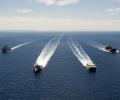
"Two destroyers, one maritime patrol aircraft and a helicopter of the Japanese Maritime Self Defence Force (JMSDF) will participate in the exercise whereas INS Rana, INS Shivalik, INS Karmukh and fleet tanker INS Shakti will represent India," the Indian Navy said on Friday.

In a region increasingly shaped by competition and coercion, such collaboration strengthens security without confrontation, builds capacity without dependency and promotes order without domination, points out Dr Kumar.

In the Indo-Pacific's new era -- where perception shapes reality faster than treaties -- the real entrapment is not of China or the United States. It is the test Japan has set for itself -- and whether partners like India, acting as balancers rather than accelerants, can help ensure that the story ends in stability, points out Varun Arya.

India and Japan are set to intensify defence cooperation with the two sides likely to launch a security consultative framework involving their foreign and defence ministers.

The India-Japan joint naval exercises are a strategic signal for China, observes Dr Rajaram Panda.
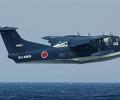
New Delhi's growing defence partnership with Tokyo could take wing with the US-2 (Utility Seaplane Mark 2), a one-of-a-kind amphibious aircraft that has Indian naval planners goggle-eyed.

Police officers on duty at the venue where former Japanese prime minister Shinzo Abe was shot didn't recognise a suspicious man in the crowd until hearing the first gunshot, Japan's public broadcaster NHK reported on Saturday.
Rediff.com's Vipin Vijayan, who is travelling with Prime Minister Manmohan Singh to Japan, reports from Tokyo.

The compulsion behind India and Japan to deepen security cooperation is in response to China's growing political and economic clout and its assertive behaviour in disputed areas. This has been the key driver for bringing both India and Japan closer in the domain of security cooperation, explains Dr Rajaram Panda.

Four frontline warships of the Indian Navy participated in the 'PASSEX' exercise when the US carrier strike group was transiting through the Indian Ocean Region on its way from the South China Sea, the officials said.

When a Chinese warship entered Japanese waters, the Indian commander called on China to maintain discipline at sea. Dr Rajaram Panda explains the significance of the Malabar exercises between India, Japan and the US.

The trigger that led Japan and the Philippines to ink the deal was because of the deteriorating security situation in the South China Sea. China's coast guard increased the frequency and intensity of incursions into Philippine waters, provoking the Philippines to take countermeasures to deter China, explains Dr Rajaram Panda.

95 aircraft, 16 ships and 2 submarines from 3 countries are taking part in Malabar exercise.
In the lead up to this week Indo-US Strategic Dialogue, for which United States Secretary of State, John Kerry, will be coming to Delhi, the Indo-US defence engagement is even more intense than usual.

Indian Admirals say Malabar 2018 will involve unprecedented complexity, featuring enemy threats in all three dimensions, but especially underwater threats from submarines -- a key Chinese strength. For the first time, officers from all three navies will be posted on other navies' warships. That means Indian Navy officers will obtain the unprecedented benefits of operating on US nuclear attack submarines and Japan's highly regarded Soryu submarines.

As Japan beefs up its defences against China, both New Delhi and Tokyo seem to have decided to re-energise their relationship to ensure a strategic balance in Asia. It is a clear signal that they may be ready to work together in containing if not confronting China, says Nitin Gokhale.
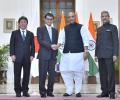
The India-Japan 2+2 dialogue added strategic heft to the special relationship in the wake of growing Chinese assertiveness on regional affairs, points out Dr Rajaram Panda.

Shigeru Ishiba is expected to prioritise strengthening Japan's military capabilities and fostering deeper international partnerships, particularly with India, with whom Japan shares significant strategic interests, explains Dr Rajaram Panda.

Japan could soon be the second country after the US with which India has a logistics support agreement. Besides the LSA, India and Japan may also sign a maritime domain awareness agreement which would enable the two navies to share information. For example, if a Japanese P-1 maritime patrol aircraft detects a Chinese submarine in the Indian Ocean, it would pass on the information to the Indian Navy, reveals Ajai Shukla.
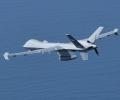
In a late night statement, the White House said completion of these sales would increase bilateral defence trade to nearly USD 19 billion, supporting thousands of US jobs.
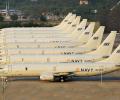
The sources said the military brass is considering deploying Indian Navy's MiG-29K fighter jets in a couple of air bases in the northern sector as part of efforts to bring in tri-services synergy in dealing with national security challenges.
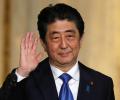
It is for the investigating agencies to probe all aspects of the assassination, including a possible Chinese hand, or if the killer was just a disgruntled element who acted on his own and wanted to earn some dark space in history like Nathuram Godse or Lee Harvey Oswald, notes Japan expert Rajaram Panda.

The government has adopted a multi-pronged approach involving the Army, the Indian Air Force and the Navy as well as diplomacy and economic measures to send out a firm and clear message to China that its misadventure in eastern Ladakh was not acceptable at all.
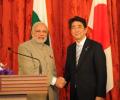
India and Japan are natural partners at sea, and Narendra Modi's recent visit underlined the need to keep the association going

Announcing the hotline, the Chinese defence ministry said as agreed upon by the defence departments of China and Japan, the two sides have recently completed the construction of a direct telephone line for the sea and air liaison mechanism and will maintain communication on the arrangement for the launch.

The 19th edition of the Malabar naval exercise saw the Indian, US and Japanese maritime forces participated jointly in the routine.

The agreement provides for creation of an enabling framework for closer cooperation and interoperability, besides allowing militaries of the two countries to use each other's bases and facilities for repair and replenishment of supplies, the official said.

Both have been robustly muscular leaders who began as immensely charismatic politicians conveying an impression that they were makers of history, raring to go. Both have been hyperactive on the world stage. But in the final analysis, Abe is departing on a sombre note, unceremoniously and apologetically, observes Ambassador M K Bhadrakumar.

'Assuming the official defence allocations represent the true picture, the $142 billion figure still represents a phenomenal increase and surpasses that of Japan ($42 billion), India ($40 billion), South Korea ($33 billion) and several other Asian countries put together and shows that China is flexing its military muscle.'
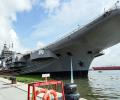
In New Delhi's corridors of power, debate continues on whether the navy even needs a third aircraft carrier.
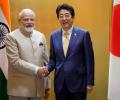
With the signing of the pact, the Quad grouping of India, Japan, Australia and the US is set to gain more heft now, notes Dr Rajaram Panda.

Taiwan says it detected multiple Chinese aircraft and naval vessels taking part in military drills around the Taiwan Strait on Saturday, in what could be a possible simulated attack against the island.
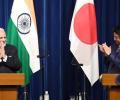
During the 13th annual summit, the two prime ministers reviewed developments in bilateral relations and explored new areas of cooperation, focusing on shared vision for peace and prosperity in the Indo-Pacific, where China is flexing its muscles.

'Singh apprised the Japanese leaders about Islamabad's 'evil design' on Kashmir at a time when Pakistan has decided to internationalise the issue.'
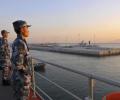
China released a white paper against the UN-backed tribunal's verdict, insisting that Beijing has claims over the strategic region for 2,000 years.

The war of words between China and the US heated up on Tuesday with an American Admiral defending last week's US naval ship's foray near Chinese-made artificial islands in the area while Beijing blasted the move as a "blatant provocation".

The agreement would divert China's attention and keep them busy in the Pacific theatre, probably resulting in a reduction in threat perception in our area of interest in the Indian Ocean, notes Commodore Venugopal Menon (retd).

'During his visit to Vietnam on September 3 -- the first visit by an Indian prime minister in 15 years -- Modi will notice the widespread anti-China sentiment in that country.'

As the pandemic unfolded, the India-China relationship has come under severe stress. To restore normalcy, agreements between the two countries must be respected scrupulously in their entirety. Where the Line of Actual Control is concerned, any attempt to unilaterally change the status quo is unacceptable, declares External Affairs Minister Dr Subrahmanyam Jaishankar.

'The defence minister needs to focus on human resources-related issues at the same pace in 2017 as he did on acquisitions in 2016,' says Brigadier S K Chatterji (retd).
 © 2026 Rediff.com - Advertise with us - Disclaimer - Privacy Policy - Sitemap - Feedback - About us - Terms of use - Grievances